RESTORATIVE-YIN YOGA involves supported body/mind relaxation. This is gentle, gentle yoga that promotes deep relaxation for stress reduction while also stretching and rehabilitating connective tissue.

Monday, February 2, 2015

Fascia Is The True Thang'


(See earlier post: “Connective Tissue” As The Locus for Restorative-Yin Yoga, 2/15/11.  Also, see posts: Slow Cookin’, 6/6/13, Deep Comprehensive Stretching, 1/1/13, Stretch& Relax, 10/2/12,Holding Yoga Poses & Spindle Release, 2/18/12)

MOVE FAST and muscles stretch.  Fascia [“Fah-shah”) is the last to stretch, and fascia stands to be stretched when held.  Popularly, muscles are sensed to be that which moves and flexes with fascia sensed to be rather immovable.  However, flow through yoga poses for a couple of months and then hold poses for a couple of months and see if you do not notice an increase in flexibility and suppleness. 

Yoga is popularly approached as a fitness alternative—but essentially as a fitness “workout”—and we tend to deliver what participants can feel, and participants can feel muscles move.  If new to yoga, muscles will likely burn the next day.  However, if poses are held and allowed to gradually stretch, muscles will likely not burn the next day.

That which we do not feel, we tend to not even sense its presence.  If we move and perhaps sweat, we feel that we are getting to that which we need to get to.  And yet, what we need to affect to gain the most obvious physical goal of modern yoga participants is to stretch fascia.

Fascia is more than tendons and “gristle.” It is a web of living tissue found throughout the body.  It coats muscle strands in three layers and is inside muscle tissue joining cells, and ultimately streams down into more recognizable ligaments at the end of large groups of muscle strands that attach muscle to bone.  Gently leach an organ such as the heart of its muscle cells and find a ghost-like heart shape of fascia upon which contemporary biomedicine has now grown a new heart from stem cells.

Fascia is not rubber.  While we may think of it at the white material in anatomy illustrations, it is living fibrous tissue., fascia is everywhere.  Fascia is structural support/strength.  It absorbs shock throughout the body.  It contains pathogens in regions so that the immune system can rush to those regions.  Full of nerve tissue, nerve communication is streamlined across the surface of fascia. (And perhaps because of this optimal nerve sensation flow, it might be strongly associated with complementary medical interventions such as acupuncture/acupressure and be a locus for understanding of “Eastern body structure”—such as “meridians”—from Western medical perspectives.0

One body-MIND aspect that may relate to fascia is the arena of trauma being held in the body physiology.  [An interview with Tom Myers, “Creating Change: Tom Myers on Yoga, Fascia and Mind-Body Transformation,” http://www.huffingtonpost.com/eva-norlyk-smith-phd/mind-body-_b_4387093.html explores fascia and trauma work.]  “Bodywork” such as Rolfing, the work of Wilhelm Reich, and Hakomi Therapy pay attention to the body in approaching emotional disorder.  There is typically some physical manipulation that is sensed to be “deep.”  It would be apparent to anyone that an experience defined as traumatic, especially chronic, is likely to be expressed somewhere in the body in chronic tension patterns.  General stress is a milder form of this expression.  Tom Myers suggests that fascia is ‘the final repository.”  He states that Most of these emotions are going to start in your nervous system.  They’re going to be exported to your muscles.  And the pattern in your muscles is going to determine what the pattern in the fascia is.  He posits that sustained stretch in yoga poses change the connective tissue.  So poses that are sustained is the key.  While it is great for physical health, exercise in the general sense—running or working out… . has less effect on the fascia, because it’s designed for the muscles, for the cardiovascular system or perhaps for neural recruitment, such as stability training. Myers stresses the necessity of giving the muscles a chance to slow down.  The muscles have to relax first, and then the fascia starts to stretch and release.  And that can facilitate the kind of repatterning that leads to lasting release of chronic holdings and, in many cases, a profound change of mind and body.

Another body-MIND aspect might involve fascia as the seat of “high-quality proprioception” (i.e., the ability to be consciously or subconsciously aware of where the localized parts of the body are.)  We might “feel” our muscles, but the muscles operate rather isolated and Via fascial connections, muscles are linked into long functional chains, and really, it’s these larger myofascial chains that are responsible for your movement. [Jenni Rawlings, “Yoga Anatomy: What Every Teacher (and Practitioner) should Know About Fascia,” http://yogainternational.com/article/view/yoga-anatomy-“ what-every-teacher-and-practitioner-should-know-about-fascia, Feb 2, 2015]  This high-quality proprioception is not just body awareness, but may be a physiological aspect of “inner vision” that opens not only body health but a reading of “integration.”

[Without much clarification, Rawlings suggests that varied movement rather than the repeated movement of  “chaturangas” may strengthen fascial tissues whereas repetition may weaken fascia and make it more prone to injury.]  But we might be asking ourselves, why 60-70 “down dogs” in a vinyasa session?  Why not explore down dog variations and move on?] 

Beyond attention to fascia, Why, Why, why we are not challenging this vinyasa flow sequence seems remarkable, and is a very, very good reason to challenge things like yoga registration?  Why are we validating Y’s exploding yoga [like exploding judo in the 1960’s, now gone] and myriad yoga studios that aspire to seek more participants?  Why are we not looking to deeper aspects, both straight-up fitness physiology that is correct, and, of course—that rarity—deeper mind-body-spirit dimensions?

Wednesday, November 12, 2014

Yoga A B C


Yoga A B C


Yoga A (“active”) tends to be fitness-oriented and/or health-oriented.  This approach is global and has outspread into a whole economy of classes, clothing/mats/accessories that creates a vocation of yoga.  It is strongly oriented toward yoga as a sequence of poses and a sense of “workout.”

Yoga B (“belief”) tends to be spiritist-oriented.  It tends to pay strong homage to either direct adoption of religious practices or incorporating spiritual motifs as well as complimentary medicinal and dietary practices.  It is oriented toward the authority of a teacher and teachings, and tends to emphasize poses either in sequences or not, and may incorporate voice.   

Yoga C (“calm”) tends to be spirituality/philosophy-oriented.  It has less to do with fitness, health, ideology, economy, or vocation.  It is oriented toward connection, liberation/freedom and is contemplative, resulting in poses that are slowed down and stillness beyond poses.   

Elements of Yoga A, B and C are not mutually exclusive with most practices being amalgams.   Yoga A is global and dominant and yet more of a fitness/health process where yoga is incorporated as a cultural motif into fitness.  Yoga B is more limited in its appeal and is sectarian in nature and Yoga C has the least presence and is morel likely to be present as meditation.

Yoga A is likely the most modern, emerging as a 20th Century Indian effort to promote an indigenous national fitness process as a political challenge British rule (and yet influenced by Western gymnastics and military fitness).  Yoga B is an effort to sustain aspects of the diverse religious ascetic practices that go deeply back into the history of cultures south of the Himalayas (with a strong contemporary global emphasis on elements from diverse Hindu sects). Yoga C is a more transcultural approach that aspires to continue the enduring ancient heritage of meditation and breath work when the term “asana” referenced “seat” and ancient art images of “yoga” primarily referenced seated postures in a variety of ascetic efforts to “yoke” the practitioner to ineffable aspects of reality.

Bottom Line: Yogic-like elements can be beneficial for fitness, health, and spirituality.  There is no pure Yoga A or B or C.  One of the contemporary issues involves trying, for example, to practice Yoga A and assume the presence of B and C when they are not present.  Contemporary practices are derivative rather than original, and can be very good for what they primarily try to do OR be degenerative and shallow and faddist “fusions.”

In this context, restorative yoga popularly references a Yoga A health practice, (and as such, is typically described as a “lower-level” body-mind practice for those who cannot do more intensive poses), but it can reference Yoga C (and as such, can reference the deepest “highest” core elements of yoga).

Personal note:  I was drawn to restorative yoga not as Yoga A but as Yoga C: slowing, deepening, stilling—as a step out of the fast-paced everyday and as a fundamental entry point into “heart-mind” that was mentioned in all of the yoga that I was experiencing but that was not really present.  This core quality can then be extended into all asanas/poses—holding, quieting, freeing rather than controlling, allowing the pose to open [See posts in Islands Of Grace on “soft power yoga”]—and into other body-mind-spirit practices such as viniyoga, yin yoga, yoga nidra, tai chi, qigong, aiki, and meditation.

Far from being rigid, participation in “yoga” that is predominantly A or B or C may follow a developmental process to some degree: 
  • Ages 0-35: A, active, a freedom of alternatives [exploring, developing a “vocabulary” of poses and styles];
  • Ages 35-55: B, belief, a freedom of discipline [refining a personal pathway]; and
  • Ages 55+: C, calm, a freedom of expanding identity [Perception of events as subtle rather than black-and-white, concepts as limiting, boundaries no longer explicit, resulting in dis-identification (letting go), opening, and then expanding, integrating)]. 

Monday, September 22, 2014

Happiness Flowers From Within


FROM ITS BEGINNINGS to the present moment, the core position of yoga is a sense of people being fundamentally good.  And this goodness is not just “good,” but essentially joyous and radiant, involving the experience of bliss at “heart center” or core being.  Accordingly, happiness and joy are envisioned as already present and inherent within--not as something one had to seek from external sources.

This core position of goodness and radiance is well expressed in yoga practice in the near universal usage of the term “namaste” and its inherent meaning:
The light within me bows to the light within you,
And when we come together in that light, we are one.

With this term, we acknowledge this inherent light—this sense of goodness and grace—in everyone and everything and in every force or action, and it takes us further, to yoke or bind us to everything as inseparable.

However, the presence of inherent goodness does not automatically guarantee happiness or joy.  Essentially yoga emerges to uncover this goodness.  The primary contribution was attention to the breath that could lead to steadying the mind that then could transcend obstacles or “sheaths” obscuring this goodness that we have created.   In yoga practice, everyone can touch this inherent goodness within oneself.  It is experienced physically and emotionally in various intensities of happiness and joy, going from simple coolness of inhalation on the lips or relaxation of release to the experience of deep emotive and integrative bliss.   These radiant experiences that occur in yoga are not simply mental assumptions.  Yoga affects neuro-chemistry.


Be it breathing or postural work or sound, yoga practice offers a freedom of discipline that provokes spontaneous physical and emotional and contemplative experiences of joy.  And repetition and consistency of yoga practice can transform these spontaneous experiences of joy into regular if not permanent attributes such as a sense of humor, gratitude, peace and harmony, and expanded sense of beauty, grace, sacredness, integration, compassion and transcendence.

Yoga practice extends into everyday life to facilitate experiences of happiness and joy.  Compassion and “Doing good things” are “right actions” that are a flowering of practice that aspires to reduce suffering (either directly or indirectly by carelessness or mindlessness).  Right action produces personal and societal and ecological happiness and joy.  There is also an interest in finding and creating beauty that produces joy.  In many everyday experiences—finding beauty in a mountaintop or ocean view or flower in the garden or soft rainfall, or lost in creativity or helping—one loses track of time and ‘I” disappears and the goodness with its bliss lives in those moments as an authentic happiness.  And gradually, by steadying the mind, one’s sense of beauty and wonder and sacredness is expanded, including even unpleasant experiences because of what they teach and how they “initiate” and therefore strengthen us.

No matter how much time is put into yoga, a quest for an imagined personal state of pure bliss can be a barrier to happiness.  As foundational yoga philosopher Patanjali suggested in his Yoga Sutras, grace and even joy can be encountered by accepting “shadows & warts” as a wonderful realization of his niyama of santosha or “contentment” that surrenders to and takes refuge in the miracle of life-as-it-is. 

Should yoga become an ongoing pathway, practice will offer joyous freshness in the mystery and opportunity for discovery that lies in the many turns that lie just ahead.


Tuesday, September 2, 2014

Unbreakable Space

Lance Kinseth, Self As Landscape 1 (detail), 2014

THERE IS AN unbreakable space within us.  It is not in our physical heart, but it is at the heart of each of us.  It is a center-point.  We are always there, but it goes unrecognized most of the time.  

There is not door or wall.  When we deepen enough, but still easily, casually, not pushing, we arrive.  There are no sheaths that surround it other than the ones that we have contrived. 

Upon arrival at what wears the appearance of a tiny little heart box, we discover that, paradoxically, it is not inside.  There is here.

It is without scale, not bounded, unsized.  And when we find that it is our homeland and where we have never ceased living, we optimize our life. And our daily actions might begin to mirror what we discover here.  And what we discover there is not clarity.  We enter this way of living in uncertainly. 

There are no words and the terrain is unwritten, and yet there is language here.   Coming alive here, our everyday transforms into the mystery that it is, and we hear languages that are the moreness of ourselves—the longer reach of ourselves that designs us and expresses us—inseparable, and here, our sensing unleashes:

            I must go out—the greenery is dense
            with memories, they follow me with their gaze.

            They can’t be seen, they merge completely into
            the background, true chameleons.

            They are so close that I can hear them breathe
            though the birdsong is deafening.
                        Tomas Transtromer, from “Memories Look At Me,"
                        The Great Enigma

We can lean back into this unbreakable quality.  We appear and we disappear and yet we endure.


Sunday, August 10, 2014

A Certain Light


Excerpt below is last 8/10/14 post from a new blog:
http://zenzawildgrass.blogspot.com

18x24, ink study, 2014

The mountains, rivers, earth, grasses, trees, and forests, are always emanating a subtle, precious light, day and night, always emanating a subtle, precious sound, demonstrating and expounding to all people the unsurpassed ultimate truth.
It is just because you miss it right where you are, or avoid it even as you face it, that you are unable to attain actual use of it.

Yuansou, from “Expedients and Reality,” in Thomas Cleary, Zen Essence

Friday, August 1, 2014

Yoga & The Digestive System


I have looked at a number of physiological systems in this blog to date, but I have neglected this important system, BUT for good reasons which are explored in this blog.  As with many aspects in this rush to understand the effect of yoga, we assume far more than we know and we are often wrong (e.g., and high calorie burn/weight loss and cure for many maladies).  It is often a fitness/wellness orientation--a health orientation--which is really not what yoga has been about for most of its few millennia of development.  Still, yoga likely has a beneficial impact on the digestive system and needs to be addressed to both acknowledge benefits as well as guard against overreaching beneficial claims [with primary attention to the impact of postural yoga, and--unfortunately--an effusive nod to the impact of the meditative aspects of yoga that are its dominant historical aspect.

A YOGA PRACTICE session may affect the respiratory, cardiovascular, lymphatic, neural, neuro-endocrine, eastern energy [chakra/meridian] systems. 

The digestive system—the integumentary system—has not been addressed to date in this blog.  This is because a description of a relationship between yoga and digestion is more difficult.  It is generally apparent that the body-mind aspects of relaxation and postural work will affect the digestive system and likely in a positive way.  However, the impact of nutrition clouds specifics because of the wide variety of nutritional intake and the impossibility (and the undesirability) of controlling nutrition in human beings.   There are wide variations in human dietary habits with very specific impacts, such as more or less fiber/”roughage” and the quality of the diet, as well as the impact, for example, of medications and alcohol and dieting.  There are variations in metabolism rates.  And there are variations in mental states and activity levels.

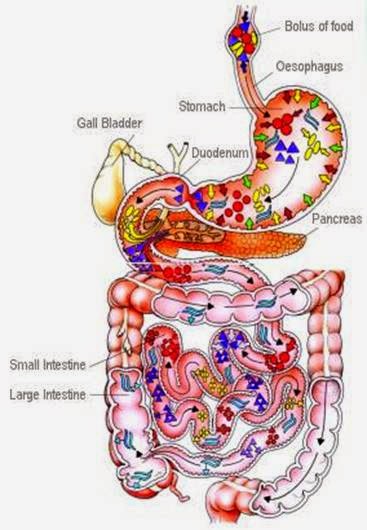
Given this inability to standardize/control, first, it is important to look at the elements of the digestive system to understand that it is more than oral salivation and stomach and intestinal actions or even “accessory organs” such a the liver, gall bladder and pancreas.


  kcoad1.wikispaces.com

Digestion is complex, and “intelligent,” without thinking/autonomic.  There is the breakdown of food into complex chemicals.   And then, there is the transfer of nutrient to the trillions of cells in the body [10-31+ trillion] that involves systems not typically described as being an aspect of the digestive system.  Further, there is the daily death of perhaps 60 billion cells and their protein that need to processed/”digested,”  and the role of the vascular and lymphatic systems in this regard.  And finally, there are ten times more bacteria than body cells  [100+ trillion, not to mention viruses, fungi, and protozoa] inhabiting the body and proportionally largely in the digestive system that are essential, but not the body per se.  And all of this is just a thin sketch of the system.


Digestion of proteins in the stomach and intestines
[intranet.tdmu.edu.ua]

What We Might Say About Yoga & Digestion

Before Beginning Practice:

While there are specific suggestions with regard to the impact of liquid and solid intake prior to a practice session, there are no universal guidelines regarding delay or no delay, volume, and specific substances. 

It is possible to come to a practice session with pre- and post-efforts to affect the digestive system.  Traditionally, Ayurvedic practices and yoga have been described, noting differences in a person’s overall body/mind type and diets related to each type.  In high sport performance, there are a variety of substances that might ingested as various points, and something like this may come into some types of yoga practice across time.  Further, there is interest in probiotics, fermented and raw food, mineral and enzyme supplements, vegan diets, colonics, etc.

The habitual dietary practices that precede and then follow the session will have a more profound impact on the yoga practice than the specific style of practice itself.  However, repeated yoga practice may begin to alter/transform dietary practices [perhaps as attention to the body makes the practitioner more aware of the impact of diet on practice].

The General Impact Of Practice Itself Upon The Digestive System:

The emotional state of the practitioner and the amount of energy that one brings to a specific session will have an impact in what is going to physiologically occur in that session.  Anyone who practices frequently will note variations in flexibility and energy even day-to-day.  And so, if a practice that felt “good” one time and then “harsh” on another time, there will be a different internal process no matter what the style of the practice is.

Further, the emotional style of the practice will have an effect.  A practice that quiets and stills may have a different impact than a very active practice.  Generally, stillness may trigger a parasympathetic response while high active practice, a sympathetic nervous system response.  Stillness/slowness/holding is likely to optimize holistic monitoring of systems to bring them into balance, while intense activity is likely to optimize core survival functions to optimize these responses and improve performance.  Digestive processes do get more “pumped” in high activity and may emphasize different processes, such as more “lactic burn” in muscles that impact differently on waste processing.

Poses such as child, a kneeling twist, cat/cow, on back with one or both knees to chest, and on back folded leg twists to side have been suggested as specific interventions.  Varieties of pranayama or breath work and abdominal muscular movement can massage the central body.  A comprehensive sequence of postural yoga including inversions will have some impact. However, due to the inability to control so many factors of human behavior, what that impact will be will likely rely on participant self-reports of either improvement or no change.

What Western Research Offers Regarding Yoga & Digestion

Cutting to the chase: Not much.  There is a vast about of research on digestion and clinical intervention with digestive disorders, but an absence of specific medical/physiological yoga/digestion research studies.  I was hoping to find some reliable information, and it is likely that there is research on this topic that I have missed.  However, when some thought is given to this topic, it becomes apparent that it is difficult to control variables, especially diet, to assess the impact of postural work.

Yoga web/blog sites have no problem suggesting yoga solutions for digestion.  Support for solutions are more intuitive feelings and personal experience.  Conclusions tend to be anecdotal evidence: involving primarily participant self-reports.  This type of evidence is typical for many body-mind studies that aspire to measure the effectiveness, for example, of yoga/taichi/reiki and cancer.  And several of these studies have been funded by national health organizations and regional medical facilities.  Further, the studies are small (and like will be due to lack of funding due to no real financial incentive for large studies as, for example, with pharmaceutical research.  Benefits reported tend to be participants’ reports of feeling better, sleeping better, having less pain, more balance, etc.  And it might be expected that staying with a process over a number of interventions will likely result in reporting better experiences [Otherwise, why continue?].  Studies of body-mind practices such as yoga have done good work on other physiological effects where they can use evidence of brain activity and fluid chemistry.  Measuring specific effect of postural work or breath on digestion would be difficult.  Again, a person’s dietary habits which vary widely as well as level of health and daily activity patterns and general attitude and metabolic rates and even dietary style.

Conclusions:

Yoga likely has a generally positive effect on digestion and may have a profound effect, and it doesn’t appear to have negative effects for most individuals.  However, reliability and validation of specific poses and specific diets remains in the realm of belief or anecdotal evidence more than fact.

Gentle yoga can be soothing in a way that is known to alter body physiology toward stress reduction.  And simply as a fitness process, more intensive postural yoga can be functionally stressful in exercising the body.  A yoga practice session tends to involve a sequence of postural work that involves a comprehensive stretch of much of the body, and this occurs throughout the practice rather than something done briefly at the beginning and/or end of exercise.  And yoga typically has a variety of inversions and twists and squeezing compressions of the central body [somewhat akin to massage and acupressure but typically more generalized] that are distinct from other forms of exercise.

Further, beyond exercise, there is a relaxation component that is important in yoga practice that soothes and calms and quiet, and that offers the experience of “release” even in a very active practice.
           
It is often suggested and likely very possible that yoga practice itself can, across time, modify dietary habits of some participants, both by developing body awareness and by intentional association with a more optimal general or specific strategy such as Ayurveda.