RESTORATIVE-YIN YOGA involves supported body/mind relaxation. This is gentle, gentle yoga that promotes deep relaxation for stress reduction while also stretching and rehabilitating connective tissue.

Thursday, March 31, 2011

Flow

Copyright Lance Kinseth, Becoming Rain, 24”x30, 2002

Soft rain into the opening Earth
Yet nothing has ever ceased streaming:
River, flower, body, mountain, Earth, galaxy.

“APRIL SHOWERS” evoke “water stream consciousness.”  Everything in the cosmos is flowing—air, Earth, star—but water is a wide-open obvious gate.

Consciousness: 85% of the brain is water, maximizing the electronic capability of a water molecule, having an angle of 104.5 degrees to make water off-balance electronically—the stickiness of water, as substance that contains more space between molecules than most substances so that substances can be added to water without increasing its volume.  Water snaps together at electronic speed, with such bonding force that only water is likely to escape from the fluid mass.

Globally, there are tens of thousands of rainstorms daily that seem to magically produce their opposite: fire/lightning.  But until this point in time, in the prevernal season in the heartland of North America, rain has been lost, stolen or strayed.  Now, rainless melt accrues in my homeland, visible on the surface of the land and flowing unseen into vast underground water tables, and beginning to stream upward in plants and higher still as evaporation.  And the rains follow the melt, with each good rainfall releasing perhaps sixteen million tons of water per second—a one-inch rainfall, ten tons of rain per acre.  Each drop of rain has swollen perhaps a million times larger than the original cloud drop.  Rain on the river dissipates into millions of rings per second.  These rings are, in turn, woven to the eye and continue to flow as impulses through billions of neurons interconnected by trillions of synapses.

In spring in the heartlands, the rains leap into consciousness.

Rain and the flow of water open imagery:

The Easter moon is up—thin and pale.  Last night much rain. 
There are puddles to be seen but not big ones.  The rain drops
 off the window above me and lands on my head in choir.
Thomas Merton, The Sign Of Jonas [p. 99]

Thomas Merton’s listening to the canticles of rain on the tin roof of his hermitage—listening to the speech of the rain that comes to all without discrimination, a holy water that cannot be controlled—as well as his contemplation of the “waters of Siloe”—“waters” of a deep stream of monastic practice;

currents of respiration and digestion, wind and water as life itself:
life: breath; breathe/respiration + water as the birthplace of life and the dominant body constituent [65%] and essentially the key dynamic of the body;

vinyasa—the flow of yoga asanas in conjunction with the breath;

flow of moments/time;

flowing movement and flowing heart-mind—zan [Jap.] “unbroken;”

flowing wind and water: being in harmony ( [Chin.] he [“huh”])
with fluctuations: calm/quick, contractive/expansive
yin-yang [Chin.], in-yo [Jap.];

pliancy: (  [Chin.] rou [“row”]= soft):
receiving/yielding;

風  流 Furyu [Jap.] “the beauty of wind and water”
[wave +waves within wave, wind curves in snow, wind swirling in grass, cascading stream];

Softness eroding hardness; mollify vs. intensify; non-resistance [wha (K.]
open/receptive vs. planned; mushin—not dwelling in a particular place—free, like water; for awareness to grow;

Mihaly Csikszentmihalyi, Flow: The Psychology Of Optimal Experience. NY: Harper & Row, 1990: “Flow”— being “in the zone:” “The state in which people are so involved in an activity that nothing else seems to matter.  The experience itself is so enjoyable that people will do it even at a great cost, for the sheer sake of doing it.
This is optimal flow, but there is a sense of flow in fluid participation in life and in encountering a sense of grace or “epiphanies” in the world as it is—in bird song, in a falling leaf, in rainfall and in the fragrance after rain, in the smile of another, by sharing food and conversation, in either the quietness or cacophony of sound in a space, in listening to music or producing a passage of music, in gardening and in walking.

With only very facile water stream consciousness, we miss our daily average direct and indirect use of perhaps 2000 gallons of water, drinking, cooking, flushing, bathing, laundry and dishwashing and food and industrial production.  The way that we overlook the role of water speaks to the way that we overlook most everything. 

In coming to intentional quiet practices such as restorative yoga, we might begin to slow enough to listen to the talk of the rain and to find much more there that we had anticipated.  We might begin to offer up our admiration, and optimize our life by coming into harmony the most abundant single substance of the biosphere that essentially comprises each of us. 

Friday, March 25, 2011

Spirit


Copyright Lance Kinseth, Illuminating Way/Eido, 2011

AN OVERRIDING GOAL of body-mind practices such as yoga involves integration and/or harmony between the innermost aspects of oneself with the universal.  The origin of yoga can be traced back literately to the very oldest of these scriptures, the Rig Veda, which speaks about ‘yoking the mind’ to the ‘highest truth’ and similarly, in the Brihadyogiyajnavalkyasmriti [Ch.2, V.49], “to the union of Jiva (individual consciousness) with Brahma (universal consciousness)” [Yogacharya, www.discover-yoga-online.com/yoga-definitions.html].           

More than body practice of keeping the body fit and supple, body-mind practices such as yoga involve, as Judith Lasater notes a gradual transformation of “ ‘good’ dis-identification with a false identification” [judithlasater.com].  When this occurs, “body-mind” practices consciously open an additional, larger dimension—that of spirit.  “Spirit” is an inclusive term with many meanings, but uniformly references an experience of connection between events as well as the inseparability of events.   In more personal terms, body-mind-spirit involves a sense of self-growth, moving from a real yet limited identity of self as internal and separate and stronger to an identity of one’s nature as beyond self, transpersonal, and interwoven with all of one’s experiences.  Developing inseparability is not something that we have to do, but rather is a natural state to which we can bring our awareness.  And “yoking” individual consciousness with universal consciousness is not just an aesthetic practice, but rather a practical path to optimal health.

The core experience of “spirit” is not finally something “ghostly” or ethereal, but rather, ecological.  In Western scientific understanding, the spring blossom is the consequence of the tilt of the whole Earth toward the sun.  The smallest flower petal and each tree leaf and each human life is an expression of the universal.  Even the sun is a dust speck that expresses the ongoing creation of the universe. 

In First Nation through post-industrial spiritual practices, this Western ecological sense of inseparability is intuitively encapsulated in phrases such as “ A seed is a star” [paraphrased from Dogon culture] and “The whole world is a single flower” [e.g., Seung Sahn, The Whole World Is A Single Flower. Boston: Charles E. Tuttle Company, 1992].  Accordingly, we are admonished to open the spiritual dimension in everyday life--to listen “to the talk of the flower” [Zenkei Shibayama, A Flower Does Not Talk. Rutland, Vermont: Charles E. Tuttle Company, 1970, p. 205].

Typically, attention to the nature of existence and to a transforming and expanding sense of identity is approached as aesthetic insight that can seem distant from our everyday life.   However, this is a practical insight that applies to concrete, everyday reality.  Real, solid, concrete, everyday health occurs as a result of being inside a larger circle of inclusion and support, and not just as something inside one’s body.  Optimal health involves consciousness of this larger identity to then “optimize” everyday experience by making it be in congruence with this larger reality.

The physical calmness and larger time-space of restorative yoga offers an opportunity to touch this heart meaning of the term “yoga.”  The centrality of relaxation and quietness in restorative yoga and relaxing for longer periods of time may enhance our attention to listening to the body and environment of practice to then optimize a holistic widening, broadening, and deepening of our sense of ourselves. 

Friday, March 11, 2011

Sacred Space


Copyright Lance Kinseth. Tranquil Way/Jakushitsu, 24”x24, acrylic, 2007

IN THE ALCHEMIST, Paulo Coelho has written beautifully, “When we strive to become better than we are, everything around us becomes better, too.”  However, if we strive to become “special,” everything around us may be diminished and distanced from us.

 “Sacred” space tends to be associated with “special” space.  But the more special space becomes, the more we are distanced from it, and unable to see spirit and sacredness in the everyday.  There is not really anything around us that is not either miraculous or magical.

Every space is an “energy vortex” of sorts, deep in the abyss of the universe.  Restricting sacred space to limited special places reflects our limits—our sense of not understanding the depth of where we are at any moment as well as our inseparability from the ongoing creative process of the universe.

Coming into restorative practice, we cross over a threshold, going from everyday routine to a place of stillness.   When ever space is viewed as sacred space, creating a sacred space references optimizing our sense of sacredness that is inherent rather than creating a special place.  After “crossing over a threshold,” small rituals that affect sensory awareness enhance the opening of our awareness of inherent sacredness.  This may be a gesture of gratitude-silently saying gratitude and/or offering a small bow, the use of sound and/or fragrance, or creating a different quality of light from the everyday experience, such as very soft light and/or candles.  This is not unlike an artist preparing a canvas or a musician preparing an instrument.

Such a process can transform the words and actions that follow.  The words that follow can be anticipated to be different, perhaps more heart-felt as well as giving consideration to a larger frame of reference than oneself.   In the experience of healing, this can alter the questions a person may bring from self-centered interests to a larger question or answer.

Characteristics that can optimize the experience of the inherent healing and sacredness of  Restorative-Yin practice space:
·      Open comfortable postures;
·      Intentional relaxation: stilling the body/ slowing breath and/or following breath, a conscious return to silence;
·      Attention to sensory elements that alter routine sensory experiences:  soft light, sound [music, natural sounds, softer voice tone, eloquence of language], fragrance;
·      Develop an attitude expressed by this space or “container”: trust, calmness, deep comfort, expansiveness/connection; and
·      Overall, establish a sensory ritual for transforming from the profane to the sacred: i.e., removing shoes, a quiet gathering needed materials for a practice session, a softer lighting and/or candles, swaddling or wrapping oneself in a blanket to reduce sensory stimuli, incense as fragrance or flowers, a particular sound, a particular built or natural environment, a particular matt arrangement, etc.

Many of these qualities are inherent in Restorative-Yin Yoga, and can be brought to more intentional awareness as a crucial element of the practice.


Tuesday, March 1, 2011

Breath


Copyright Lance Kinseth, Shining Spring/Shun Sho, 2011

North’s bow to the sun
Spills the ocean of sky.
Treetops become windsingers.

WINTER IS FALLING APART.  And with its fall, March winds bring awareness to breath. 

Perhaps a hundred thousand miles of wind pass overhead annually—freshness endlessly replacing freshness.

Each hour, we might take 700 to 900 breaths, perhaps 20,000 breaths daily, and more than 150,000 breaths weekly. Air is dynamic, not static, with oxygen moving at a thousand miles per hour at a cool room temperature of fifty degrees Fahrenheit [but blazing hot in the context of the universe], colliding continually every 1/10000 inch.

Each breath offers a communion of sorts: Each breath easily contains several thousand- billion-billion atoms—breathed by living organisms  and past living biota, and atoms once comprising the bodies of most plants, animals and people, and atoms from the oceans, the body of the Earth, and all atoms, originally from generations of stars. We image the breath as offering us refreshing oxygen, and it does.  But each breath contains a taste of nearly everything—powdered glass and quartz and mica, carbon particulate from exhausts, meteoritic dust, plant spores and pollen, viruses and encysted bacteria, radioactive iodine 131, cesium 137, and on and on, ad infinitum. 

Looking like next to nothing, the encompassing atmosphere is dense and even weighty.  Each cubic inch of atmosphere contains perhaps 440 billion billion atoms.  We live in the belly of an abyss of atmosphere.  We wear a half-ton robe of atmosphere that sustains a temperate climate [that glows with radiant energy] and shields us from harsh solar radiation.

Attending to the breath, body and mind come directly together.

We might attend to the breath just as it is, imagining breath as a wave or a horse and our mind, a rider. 

Remaining calm, the body begins to “soften” the breath.  Practically, softening the breath corresponds to lengthening the inhalation/exhalation breath cycle.  We might intentionally imagine inhaling into the belly or lifting the lower ribs that fills the lower lungs and eases the lengthening of the breath.  The rate of respiration gradually decreases, but oxygenation remains either stable or is enhanced and, gradually,
  • the parasympathetic nervous system may be stimulated (lowering both heart rate and blood pressure), and
  • neurochemistry may be altered, increasing the production of  alpha brain waves and the reduction of reactivity to stimuli.
Consciously attending to the unconscious, “automatic” breath, we gradually do more than physiologically calm and quiet ourselves.  Body and mind calm, expanding attention both internally and externally.  In the calmness and quietness, we begin to listen to the body, to observe thoughts coming and going.  Our language and thoughts may gradually begin to blossom beyond everyday chatter. 

As body and mind come together, there may be an increasing sense of the integration—“the coming together,” the inseparability—of all of our experiences.  The calmness enhances our ability to listen deeply to the body, perhaps opening an increasing sense of intuition—of hearing something very authentic emanating from within that is offering us away forward in optimal health.  

Friday, February 25, 2011

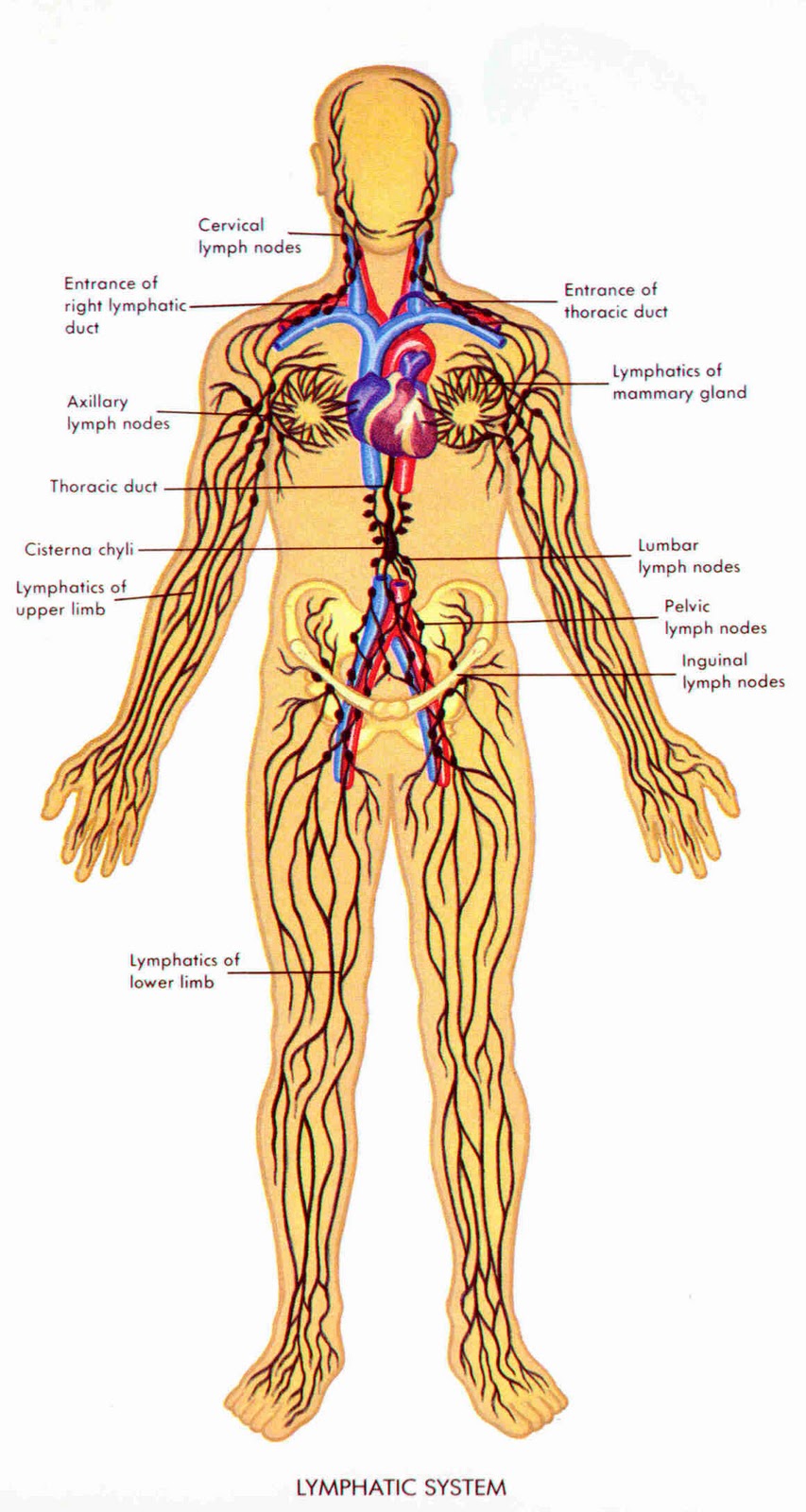
The Lymphatic System

Supported Legs Up The Wall Inversion Pose


[SEE ALSO: Later March 1, 2012 post: The Lymphatic System & Yoga II]

THE LYMPHATIC SYSTEM drains watery clear fluid [lymph] from cells and returns fluids to the blood to maintain fluid balance.  Major functions include absorption of lipids from the intestines and the circulation of lymphocytes [immune cells that protect against antigens such as viruses, bacteria and molds].  Lymphocytes are produced in the bone marrow [T-] and spleen [B-], enter the blood, pass into the capillaries, and then into the tissue.  Bean-shaped lymph nodes [2-3 centimeters] provide a major site for lymphocytes to engage antigens.  Lymphocytes are a type of white blood cell that involve both "naive" and  "memory" cells.   Naive cells recognize new "infections" and then adapt to eradicate "invaders."  Memory cells were once "naive" cells that became "memory cells" that recognize previous "infections," and they clone themselves to fight off infection.  With age, we tend to maximize memory cells that can reduce immunity.  Exercise may flush the oversupply of memory cells and replace these with naive cells.

While the vascular system has the heart for a circulatory pump, a low pressure “flow” [peristalsis] for the lymphatic system is created by muscular/skeletal activity.  The lymphatic system is concentrated in the tissue of the neck, armpits, and groin, but also significant in the heart, lungs, intestines, liver and skin.

Leslie Kaminoff, Yoga Anatomy, Champaign, IL: Human Kinetics, 2007, p.18,
[Illustration by Sharon Ellis]

Supports utilized in restorative yoga combine with the openness of the poses to optimize attention to the lymphatic system.  Supports reduce muscle constriction, and the sequence of poses often feels more open.  The hips open, arms spread out, and muscles relax.  Gentle inversions drain fluid into the lymph glands.  Gentle twists and gentle bends massage the internal soft tissue.  Overall, restorative poses are less constrained. 

Friday, February 18, 2011

Living The Questions


Copyright Lance Kinseth, How Many Pounds Does Your Mind Weigh?/ Korean Son [Zen] Master Hae Bong, 19”x33,  1997  

A SECOND EXCELLENCE of yoga admonishes one to set an intention for the practice session.  For someone new to yoga, this may be as simple as exploring what this practice is like.  By returns to practice, there might be a very personal intention to experience subtle elements more directly, such as grace, elegance, and flow.   Often, a strong reason for setting an intention involves enhancing some aspect that can be taken from the practice into one’s everyday life to enrich the quality of one’s life or that will serve others.  The practice might simply be dedicated to someone.  Typically, this setting of intention is done near the beginning of the session.

It may be useful at times to not set an intention immediately, but rather, to let it arise from the practice, from one’s intuition.  And when that time comes, we might ask, what it is that we need from this practice at this time.  Perhaps such an intention might be one of aspiring to open or to listen.  Especially in the calmness and quiet of restorative-yin practice, our language changes and our thoughts might deepen. 

Setting an intention can feel good, as if setting a goal and then making progress.  But this may also be an impediment.  Progress and answers are what we try to do in everyday life.  Coming to a practice of calmness and quiet is, itself, an intention.  And it can open new information.  The calmness and quietness and a return to silence enter a deeper landscape in and of itself, without further intention.  We come to any practice with some sort of a quest, perhaps seeking some favor or change.  But what may occur is that the questions that we bring will change as our calmness deepens.  And touching this deeper life does not always consummate in an explicit meaning or “answer.”  We are likely to receive another question that takes us beyond the smallness of our original question.   And this question becomes a strong answer, because of the sense of emotional and intellectual quality that it offers.  It opens into a larger landscape that we expect.  And this question may open another question, so that the “answer” is more a process of opening and searching and being receptive.   The flow of questions may awaken us.

Our rock-firm answers might feel good for the moment, but they can pale against the questions.  The questions become gates that we pass through; they become cairns or marking stones that we pass along the pathway, with the next turn of the path ahead opening another bright nuance.  We glance back and see how far we have come, and we gaze ahead and see how far we have to go.  In so doing, we arrive more graciously where we are.  We begin to live the questions rather than seek answers.  We open like a blossom and our life pathway becomes a living answer.

In a body-mind practice, we are likely never fully answered.  But the practice becomes more subtle, and this subtly, more rewarding and implicitly meaningful without ever coming down to an explicit meaning.

When that time comes in the calmness and quietness, we intuitively receive an intention that we can live out to better understand ourselves, to better understand our immanent and global experience, and to evoke kindness.  We can smile both to our joy and our anger, approaching them as questions that offer and open us and cease being walls.

Thursday, February 17, 2011

Pathway I

Copyright Lance Kinseth, Way Of The Heart/Doshin, 2011

TYPICALLY, WE LOOK at a practice like restorative yoga as offering a number of positive physical health benefits.  It is different from exercise and fitness that intentionally stresses the body for controlled periods of time.  We may distinguish this practice by describing how brain activity is manipulated to regulate physiology [reducing heart rate and blood pressure] as well as to relax total body physiology to restore the body.  We may note possible positive effects on mental states such as anxiety and depression, but even these are largely attributed to body physiology.

Overall, we may point out that the strong mental emphasis really makes this a “body-mind” practice rather than a body practice, as with other exercise, but, even here, we tend to describe the mental effect that provokes health in physical terms.

We may miss perhaps the greatest benefit:  We tend to see our lives as something that happens to us, as a pathway from birth to death, of trail and error, with triumphs and loss.  But we miss the key pathway that we, ourselves, forge.   In a body-mind practice that prioritizes quiet and calmness, we have an opportunity to cut deeply through the chatter of the everyday to the deeper internal chatter that subconsciously directs our actions.  Listening there, we may begin to profoundly affect the choices that we make and enhance the quality of our lives and others.  Because of the sustained calmness and quietness of the practice, across time, we can look deeply at our life journey—what it is for which we are living. 

Poet John Keats admonishes us:
I compare human life to a large mansion of many apartments,
two of which I can only describe.  The doors of the rest being
              as yet shut upon me.

The deep chatter may guide our life to be self-limiting and even self-destructive.  From our positive and negative experiences, we have a subconscious life plan—how long we might live, how long we want to live, what we might expect from life, how we imagine and then treat our bodies, how we describe or define ourselves in terms of specific roles and vocations, etc.  This can limit us. 

Perhaps our greatest fault is, as Nelson Mandela suggests, not an issue of overcoming our limits but rather a lack of recognition that we do not have limits. We have passions and dreams that are more open-ended and often integrated and harmonious.  They reflect a preconscious plan that has been with us since birth.  There is an inherent drive in us toward “psychosynthesis” that aspires to bring the pieces of our lives together in harmony.  Each person uniquely expresses it.  It might be reflected in superficial things like a favorite book or movie or events that attract us or memories that stay with us out of all of the myriad possible memories that have somehow touched us deeply, because they resonate with this path that we are on.  Why this book or movie?  There is a theme that we are likely pursuing, but it is often subconscious.  These passions and dreams are the “bones” of a rich pathway of “that for which we are living” that can be optimized, if discovered, and then more consciously expressed.

Our “exercise”—be it unabashed exertion or gentle body-mind—that seems health-oriented can reflect limits.  It may be driven by a sense of anxiety that has been scripted long ago.  It may be defensive and oriented more toward survival than toward thriving and growth. 

However, even with no conscious intent to cut through the chatter, regular body-mind practice that is quiet and calm may begin to transform us more than we had anticipated.  We may begin to relish the calm, and so, aspire to “live this calm” beyond the practice session.  Long-term body-mind practitioners typically move beyond describing physical benefits as primary.  They have continued in these practices because they experience improved psychological and social and spiritual health.  And they can begin to describe these changes in very concrete terms.   They might describe living the everyday in a calm state: being less reactive, more in touch—opening/listening, having more of a sense of humor, and having a deeper sense of meaningfulness in a broader range of experiences and a deepened sense of appreciation and gratitude.  They feel more engaged in life. 

They may increase a sense of harmony between the different aspects of everyday life so that they different aspects begin to nurture each other.  In vocations and avocations [passions], they may begin to see how that for which they are living is personally expressed.  For example, a teacher may see how a very general subconscious theme of peace is specifically expressed in all of the facets of her work with children.  And artist may find a subconscious theme of harmony expressed across the oeuvre or body of his or her work.  This growing consciousness of one’s life plan can both optimize the quality of everyday life and move one’s activities from a sense of leading a half-life to a sense of life becoming more authentic or “real.” 

As the theme splays out into more and more aspects of one’s life, life can be experienced as having become richer.  Compassion, specific experiences of awe and wonder and grace both in one’s own experiences as well as in the observation of the larger world can be specifically described and repeated and supported in others.  Metaphors such as “integration” and “harmony” and “wholeness” enter language and do not remain “lofty” or “exclusive” or “special.” These attributes may increasingly become “normal” and “inclusive”—less defensive and more outreaching and giving to a degree that supports others and encourages these attributes in their actions.

Quietness and calmness form the architecture of an eloquent gateway to this deep way of the heart.