I have looked at a number of physiological systems in this blog to date, but I have neglected this important system, BUT for good reasons which are explored in this blog. As with many aspects in this rush to understand the effect of yoga, we assume far more than we know and we are often wrong (e.g., and high calorie burn/weight loss and cure for many maladies). It is often a fitness/wellness orientation--a health orientation--which is really not what yoga has been about for most of its few millennia of development. Still, yoga likely has a beneficial impact on the digestive system and needs to be addressed to both acknowledge benefits as well as guard against overreaching beneficial claims [with primary attention to the impact of postural yoga, and--unfortunately--an effusive nod to the impact of the meditative aspects of yoga that are its dominant historical aspect.
A YOGA PRACTICE session may affect the respiratory,
cardiovascular, lymphatic, neural, neuro-endocrine, eastern energy
[chakra/meridian] systems.
The digestive system—the integumentary system—has not been addressed to date in this blog. This is because a description of a
relationship between yoga and digestion is more difficult. It is generally apparent that the
body-mind aspects of relaxation and postural work will affect the digestive
system and likely in a positive way.
However, the impact of nutrition clouds specifics because of the wide
variety of nutritional intake and the impossibility (and the undesirability) of
controlling nutrition in human beings. There are wide variations in human dietary habits with
very specific impacts, such as more or less fiber/”roughage” and the quality of
the diet, as well as the impact, for example, of medications and alcohol and
dieting. There are variations in
metabolism rates. And there are
variations in mental states and activity levels.
Given this inability to standardize/control, first, it is
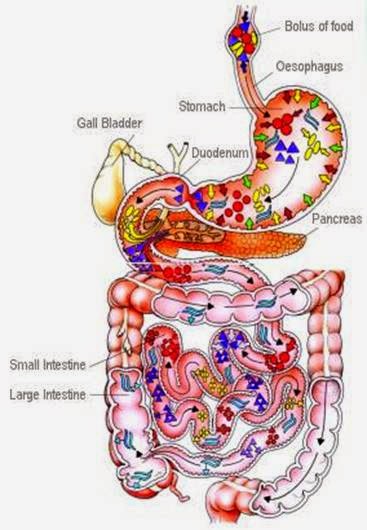
important to look at the elements of the digestive system to understand that it
is more than oral salivation and stomach and intestinal actions or even
“accessory organs” such a the liver, gall bladder and pancreas.
kcoad1.wikispaces.com
Digestion is complex, and “intelligent,” without
thinking/autonomic. There is the
breakdown of food into complex chemicals. And then, there is the transfer of nutrient to the
trillions of cells in the body [10-31+ trillion] that involves systems not
typically described as being an aspect of the digestive system. Further, there is the daily death of
perhaps 60 billion cells and their protein that need to
processed/”digested,” and the role
of the vascular and lymphatic systems in this regard. And finally, there are ten times more bacteria than body
cells [100+ trillion, not to
mention viruses, fungi, and protozoa] inhabiting the body and proportionally
largely in the digestive system that are essential, but not the body per
se. And all of this is just a thin
sketch of the system.
Digestion of proteins
in the stomach and intestines
[intranet.tdmu.edu.ua]
What We Might Say About Yoga & Digestion
Before Beginning Practice:
While there are specific suggestions with regard to the
impact of liquid and solid intake prior to a practice session, there are no
universal guidelines regarding delay or no delay, volume, and specific
substances.
It is possible to come to a practice session with pre- and post-efforts
to affect the digestive system.
Traditionally, Ayurvedic practices and yoga have been described, noting
differences in a person’s overall body/mind type and diets related to each
type. In high sport performance,
there are a variety of substances that might ingested as various points, and
something like this may come into some types of yoga practice across time. Further, there is interest in
probiotics, fermented and raw food, mineral and enzyme supplements, vegan
diets, colonics, etc.
The habitual dietary practices that precede and then follow
the session will have a more profound impact on the yoga practice than the
specific style of practice itself.
However, repeated yoga practice may begin to alter/transform dietary
practices [perhaps as attention to the body makes the practitioner more aware
of the impact of diet on practice].
The General Impact Of Practice Itself Upon The Digestive
System:
The emotional state of the practitioner and the amount of
energy that one brings to a specific session will have an impact in what is
going to physiologically occur in that session. Anyone who practices frequently will note variations in
flexibility and energy even day-to-day.
And so, if a practice that felt “good” one time and then “harsh” on
another time, there will be a different internal process no matter what the
style of the practice is.
Further, the emotional style of the practice will have an
effect. A practice that quiets and
stills may have a different impact than a very active practice. Generally, stillness may trigger a
parasympathetic response while high active practice, a sympathetic nervous
system response.
Stillness/slowness/holding is likely to optimize holistic monitoring of
systems to bring them into balance, while intense activity is likely to
optimize core survival functions to optimize these responses and improve
performance. Digestive processes
do get more “pumped” in high activity and may emphasize different processes,
such as more “lactic burn” in muscles that impact differently on waste
processing.
Poses such as child, a kneeling twist, cat/cow, on back with
one or both knees to chest, and on back folded leg twists to side have been
suggested as specific interventions.
Varieties of pranayama or breath
work and abdominal muscular movement can massage the central body. A comprehensive sequence of postural
yoga including inversions will have some impact. However, due to the inability
to control so many factors of human behavior, what that impact will be will
likely rely on participant self-reports of either improvement or no change.
What Western Research Offers Regarding Yoga & Digestion
Cutting to the chase: Not much. There is a vast about of research on digestion and clinical
intervention with digestive disorders, but an absence of specific
medical/physiological yoga/digestion research studies. I was hoping to find some reliable
information, and it is likely that there is research on this topic that I have
missed. However, when some thought
is given to this topic, it becomes apparent that it is difficult to control
variables, especially diet, to assess the impact of postural work.
Yoga web/blog sites have no problem suggesting yoga
solutions for digestion. Support
for solutions are more intuitive feelings and personal experience. Conclusions tend to be anecdotal
evidence: involving primarily participant
self-reports. This type of
evidence is typical for many body-mind studies that aspire to measure the
effectiveness, for example, of yoga/taichi/reiki and cancer. And several of these studies have been
funded by national health organizations and regional medical facilities. Further, the studies are small (and
like will be due to lack of funding due to no real financial incentive for
large studies as, for example, with pharmaceutical research. Benefits reported tend to be
participants’ reports of feeling better, sleeping better, having less pain,
more balance, etc. And it might be
expected that staying with a process over a number of interventions will likely
result in reporting better experiences [Otherwise, why continue?]. Studies of body-mind practices such as
yoga have done good work on other physiological effects where they can use
evidence of brain activity and fluid chemistry. Measuring specific effect of postural work or breath on
digestion would be difficult.
Again, a person’s dietary habits which vary widely as well as level of
health and daily activity patterns and general attitude and metabolic rates and
even dietary style.
Conclusions:
Yoga likely has a generally positive effect on digestion and
may have a profound effect, and it
doesn’t appear to have negative effects for most individuals. However, reliability and validation of
specific poses and specific diets remains in the realm of belief or anecdotal
evidence more than fact.
Gentle yoga can be soothing in a way that is known to alter
body physiology toward stress reduction.
And simply as a fitness process, more intensive postural yoga can be functionally stressful in exercising the body. A yoga practice session tends to
involve a sequence of postural work that involves a comprehensive stretch of
much of the body, and this occurs throughout the practice rather than something
done briefly at the beginning and/or end of exercise. And yoga typically has a variety of inversions and twists
and squeezing compressions of the central body [somewhat akin to massage and
acupressure but typically more generalized] that are distinct from other forms
of exercise.
Further, beyond exercise, there is a relaxation component
that is important in yoga practice that soothes and calms and quiet, and that
offers the experience of “release” even in a very active practice.
It is often suggested and likely very possible that yoga
practice itself can, across time, modify dietary habits of some participants,
both by developing body awareness and by intentional association with a more
optimal general or specific strategy such as Ayurveda.